Critical Reverberations: Sound, Infrastructure and Precarity — A Portrait in Dialogue with Jan Vorisek
Words Silvio Hadorn do Nascimento
Artist Jan Vorisek
On a Monday in mid-June, in the heat of a late Basel afternoon, Art Basel week opened in Hall 1.1 at Messe Basel with the Swiss Art Awards: the prize ceremony, followed by the exhibition opening. I had seated myself at the back of a packed audience, gathered to discover the 2026 winners and catch a glimpse of Federal Councillor for Culture Elisabeth Baume-Schneider, while Kanye West wandered through the adjoining Unlimited space. The exposed roof structure, made of steel but finished in white and punctuated by large gleaming ventilation ducts, formed a counterpart to the interlocking social realities within the gathering: political representatives, art professionals and established figures such as John Armleder. At the far end, the space seemed presided over by a giant screen on which the winners’ names appeared and at whose foot the jury members filed past, presenting the laureates in the flesh.
All in all, it was an evening marked by a certain cosy apathy, within a perfectly conventional setting. Until the lucid and grating irruption of Jan Vorisek who, receiving his prize, his eyes alert, declared himself grateful that the award had been decided by “a jury consisting of independent experts”, whose independence — amid “growing pressures on artistic freedom through funding cuts and censorship”, including in Switzerland — helped safeguard the possibility of “critical artistic discourse” and, as he implied, ensured the integrity of the process for this edition of the Swiss Art Awards. Yet, amid the uniformities composing the scene, these opening declarations gave rise in my mind to a doubt and a series of critical questions concerning the possible political and institutional considerations governing the allocation of the prizes, even as, with complete lightness, they endorsed the process through a favourable a priori judgement. In an instant, like a flash, something of Vorisek’s critical methodology had revealed itself.
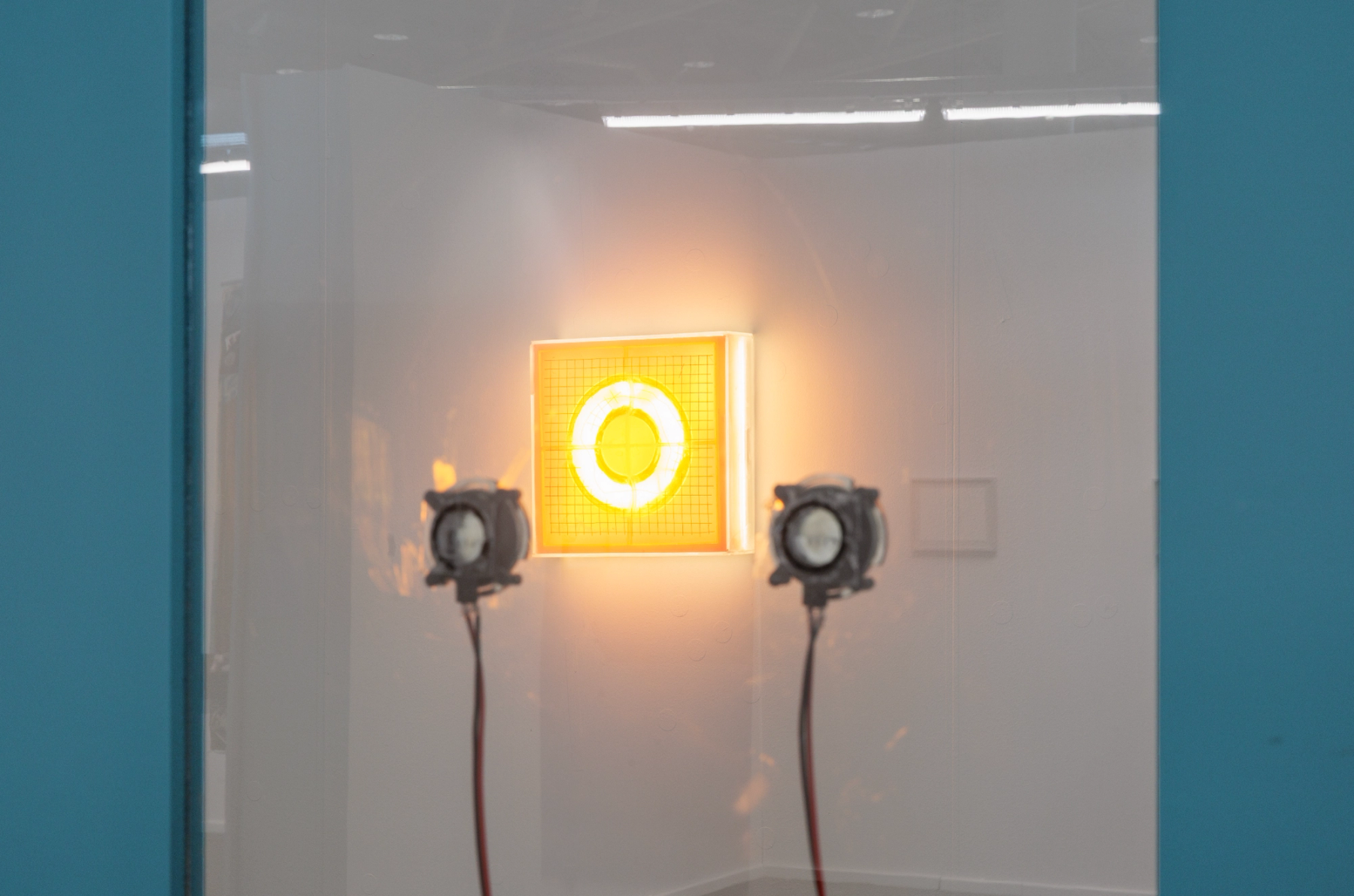
At the exhibition opening, as I wandered among the works, slowing as encounters and pieces held my attention — such as those of Samuel Haitz, Alfredo Aceto or Jacques Duboux — it was nevertheless the noises and grating crackles emanating from Jan Vorisek’s works — particularly Between me and you (2026), a blue hospital door apparently originating from a diagnostic unit or department, with small contact speakers mounted on its glazed section — that once again arrested me in a singular way. These sounds were reminiscent of potentially malfunctioning technical equipment and struck me as so many questions: What, then, is this sound? What technical infrastructure is malfunctioning? What apparatus is causing a problem here? Is it dangerous?
Arrested by the sound, I moved closer to the pieces and immediately sensed a work of great conceptual rigour, yet one that, precisely, first came alive in the sensible: an insistent sonic texture, an intriguing materiality. Immediately, an impression of imbalance, of displacement: but from where does this work speak?
Jan Vorisek was born in Basel in 1987 and completed an MA in Fine Arts at the Zurich University of the Arts (ZHdK) in 2018. Based between Zurich and Berlin, he has developed a multimedia practice spanning installation, sound, performance, video and sculpture. Selected solo exhibitions include No Sun at Swiss Institute in New York in 2021, Collapse Poem at Kunsthaus Glarus in 2020, and Edge, Hour, Substance at Kunst Museum Winterthur in 2023. He was awarded the 13th Manor Art Prize of the Canton of Zurich in 2023 and a Swiss Art Award in 2026.
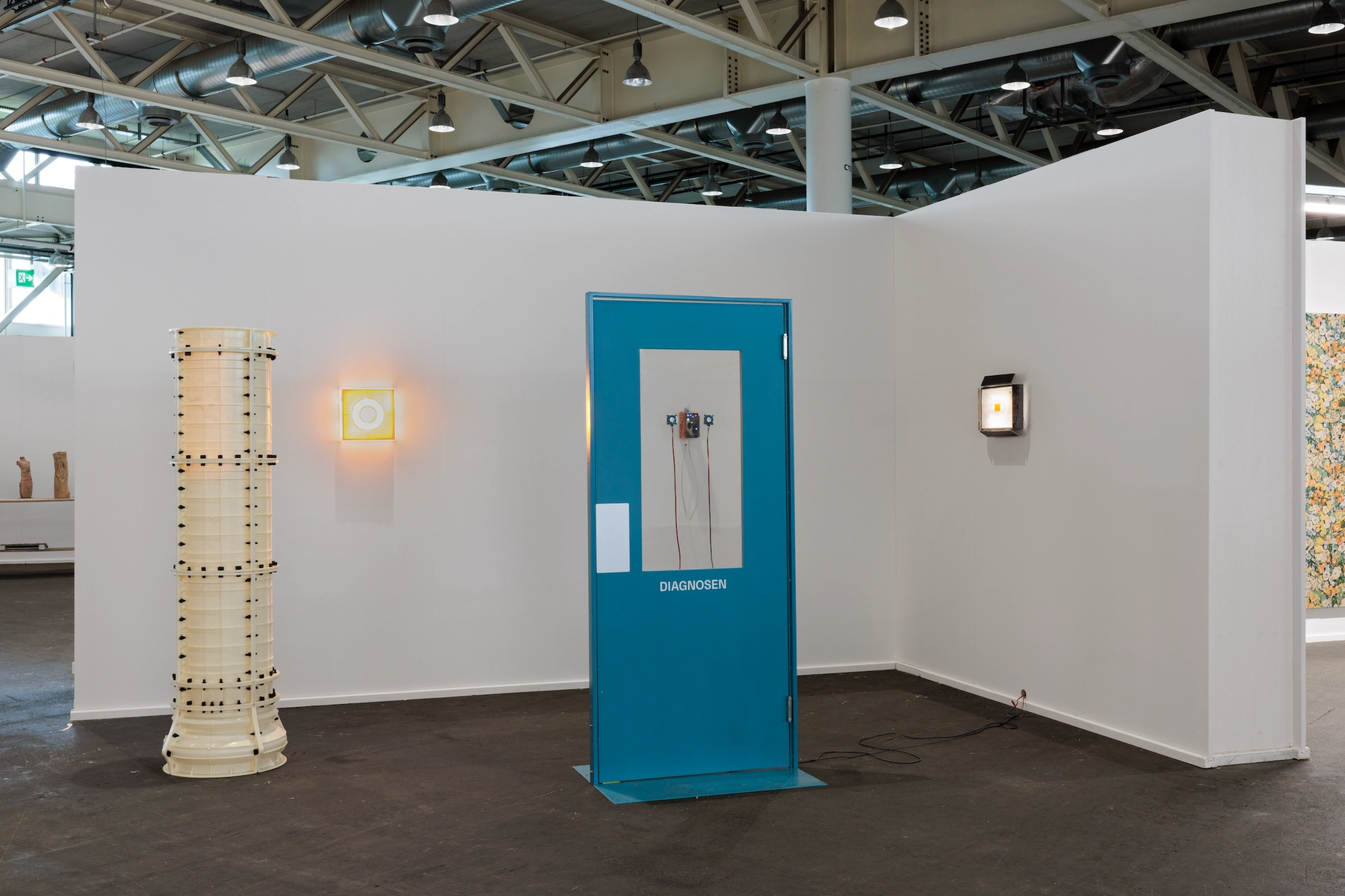
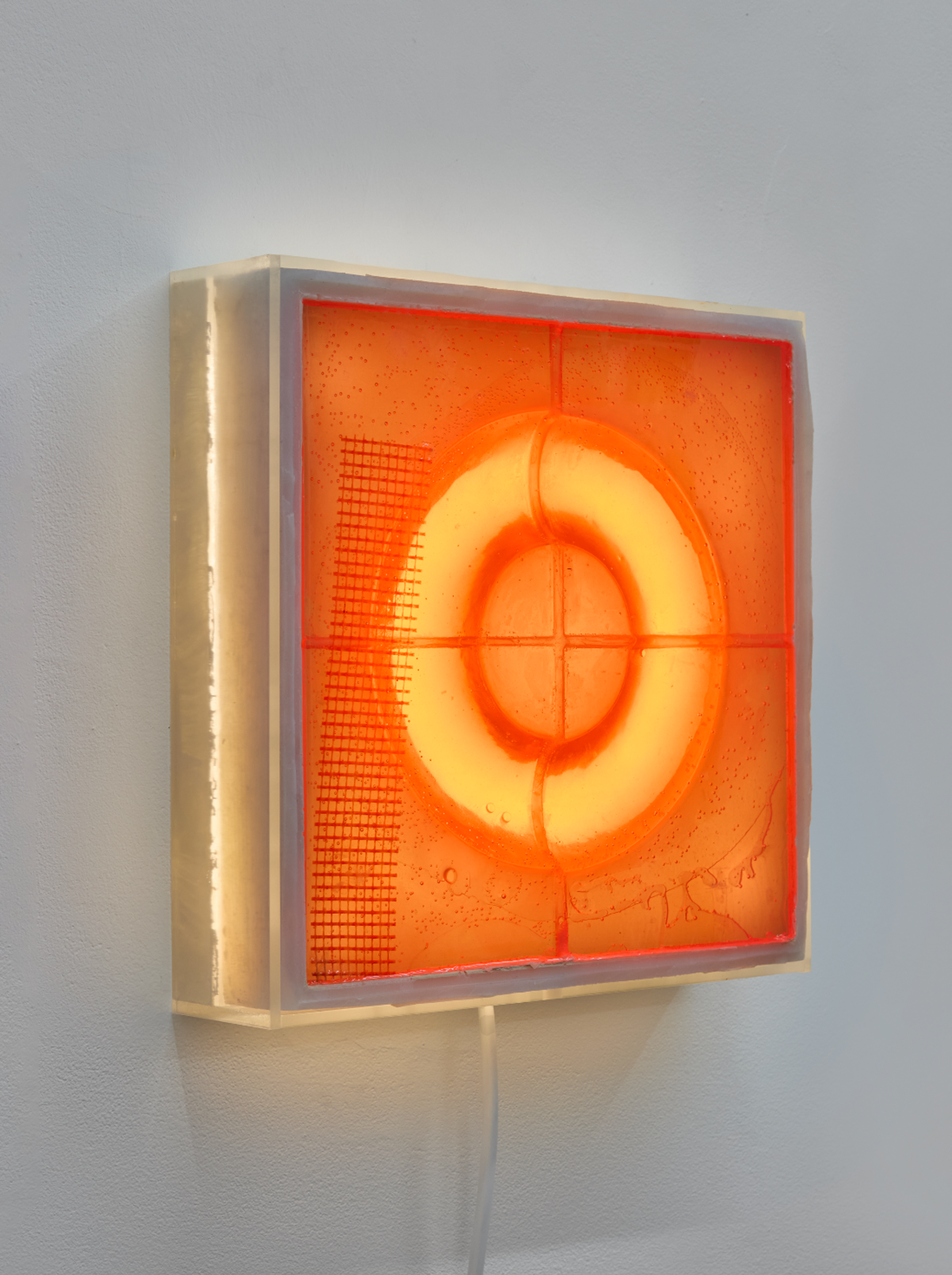
From then on, when I thought back to the works Vorisek had presented at the Swiss Art Awards, as well as to his remarks, it seemed to me that the installation and the speech operated jointly as an interface or, more precisely, as a diagnostic apparatus. In a way at once surprising and stimulating, playful and profound, Vorisek’s work brought into play the infrastructures within which his works emerge, drawing into itself the very context of their appearance and making it perceptible. The installation appeared to question the site in which it was presented and activated: it put the context itself at stake and productively brought into crisis the Swiss contemporary art milieu, as well as the mechanisms of recognition and legitimation embodied by the Swiss Art Awards. I then wondered whether, taken together, Vorisek’s works operated as so many apparatuses of infrastructural diagnosis, temporarily leading us from sounds and pieces to the networks of relations that underlie them and thus thematising their conditions of possibility. From this perspective, sound appeared to me to be a singularly effective means of carrying out such a diagnosis of the state of health of artistic organisms, institutions and infrastructures.
I set about deepening my intuitions and proposed to Vorisek that we pursue this reflection within the framework of the platform for dialogue between artists and intellectuals that I am developing alongside my research with the Aesthetics & Critique group at the University of Fribourg. He accepted my proposal, thereby giving me the opportunity to retrace with him the lines of flight of what I had first perceived, from the sensible effects of the works to the intentions and methods that had brought them into being.
I then presented my hypotheses to him. Vorisek agreed, explaining that sound transports a considerable amount of information whose basis is aesthetic: “It reverberates not only with the place in which it is shown, but also with the works it accompanies and with the visitors and people engaging with the work. On the one hand, it exists independently, autonomously; on the other, it also configures social interactions.” Sound thus becomes both medium and methodology: it does not merely make itself heard, but dynamically configures the relations between the place, the works and the people who encounter them. This horizon remains active even in its absence: “I am also always interested in the absence of sound. […] It is still somehow there: just because it is part of my practice, it becomes part of the ambience of my work.”
I told him about my discovery of the door exhibited in Basel, which led us to consider how a sensory effect can act as a trigger. Vorisek explained: “It is an affect-based curiosity or interaction at first, before it becomes more cerebral and analytical.” Looking and listening are thus caught up in a shared movement in which affects are produced and transformed; the experience oscillates between different perceptual and reflective modes. This movement testifies to an approach he himself describes as “synaesthetic”, a kind of reversible sensory transmutation that opens a field of reflection through the psychological responses it elicits. The aim is therefore not to produce a univocal immersive ambience through sound, but rather to create an “ambience of confusion”, an uncertainty that plays “with expectations, disappointment and curiosity”. Confusion is thus neither a collateral consequence nor a mere ambience: it is the perceptual mode through which the work engages the viewer, from that initial sensory arrest, in a network of questions and tensions; in so doing, the work seems to thematise the very precarity of appearing.
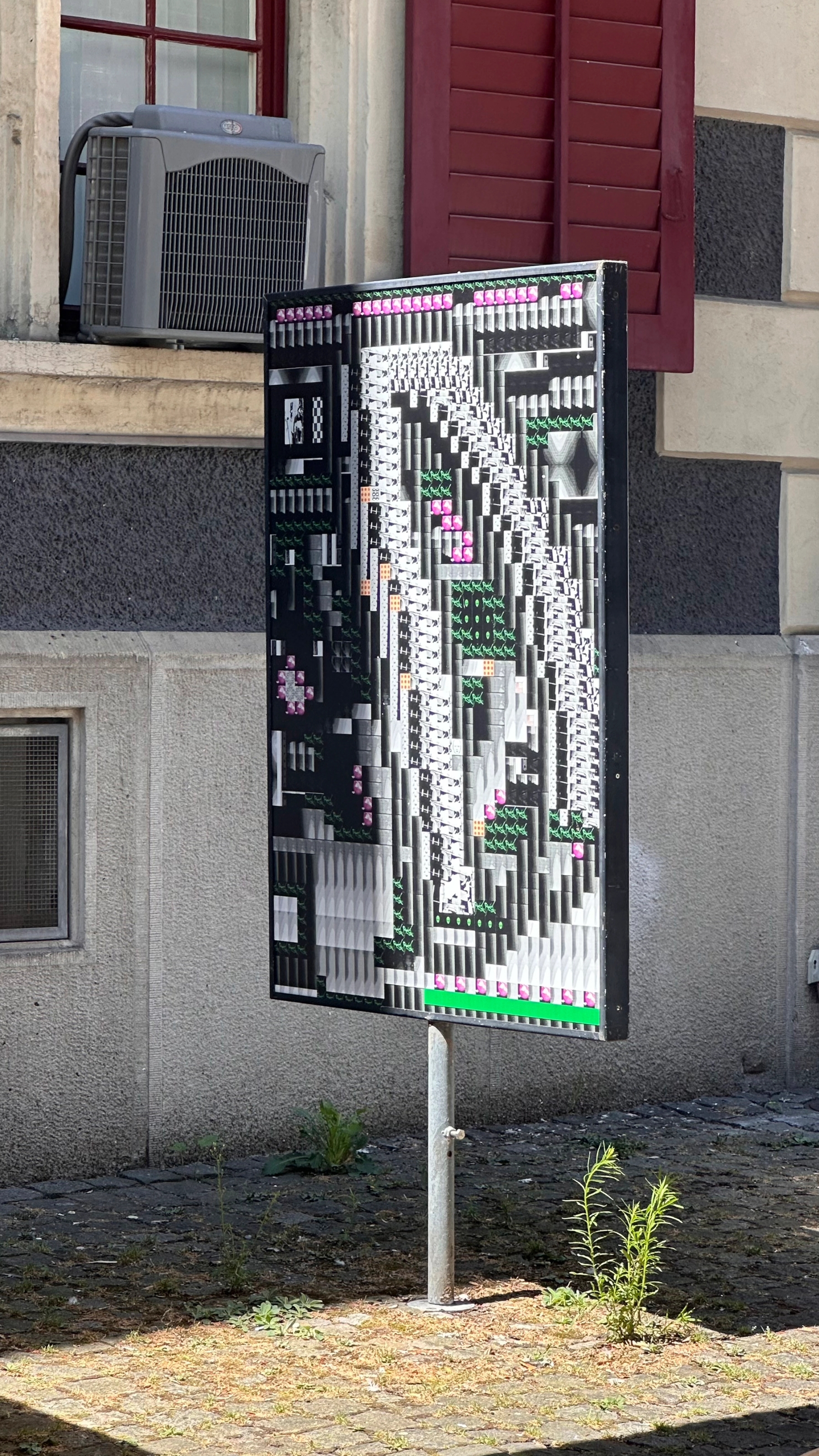
In preparation for our exchanges, I had visited two of his works currently on view in Zurich. The Space of Possible Outcomes, a series of modular images presented at Tableau Zurich until 30 September 2026, occupies the seven panels that constitute the space’s permanent display structure and whose images and orientation vary from one exhibition to another. Jan Vorisek treats them as a modular visual structure that produces a play of motifs in dialogue with the surrounding architecture. Covered with sequential motifs drawn from 2D games and mined from Vorisek’s personal archives, the panels unfold a kind of graphic magma that coagulates the context around it and renders that context legible as a fragmentary utterance within a graphic language of potentialities.
The other work, entitled Freiläufer, is an 18-metre orange wind-powered water pump, stripped by Vorisek of its functional character and permanently installed since 2024 at the foot of the Hardbrücke, on the Kreis 4 side, near a cantonal school and Zurich West prison. Beyond the dense rail network of central Zurich, it faces the Prime Tower, the Kreis 5 skyscraper. On my arrival, Freiläufer rose in luminous orange against a monochrome blue summer sky and turned gracefully with the wind. A few metres from the piece, a team of workers dressed in vivid yellow overalls was engaged in major external works. Equipped with a trailer-mounted mobile high-pressure hydroblasting unit, they sent a marvellous industrial concert reverberating across the site. Paradoxically, in the artist’s absence, the installation seemed to me to recover, from the life of the site itself, the very function Vorisek had removed from it — pumping water — reintegrating that function into the utilitarian operations of the context and, in passing, doubling the piece with a sonic layer.
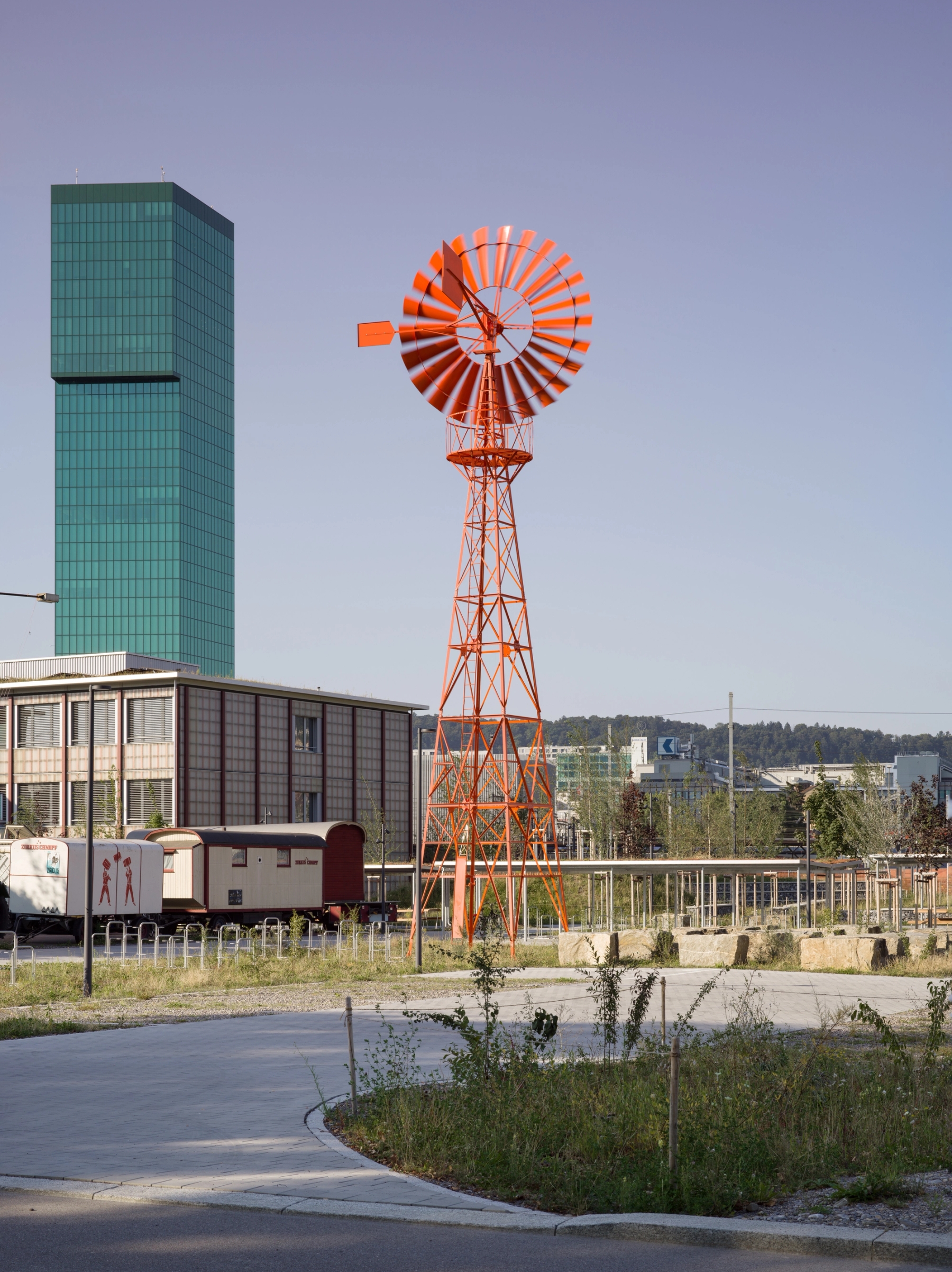
In his work, noise and sound belong to a broader logic: “everything is a found object, a found situation.” What is at stake can thus be understood as an operation of configuring these sites, situations, and materials. In and out of step, it became increasingly clear that the network of questions opened up by his work is not confined, on the one hand, to the sonic component and, on the other, to the visual, sculptural and material component, but rather unfolds between the different elements: sound, objects, materials, architecture, signs, technical apparatuses and the viewer’s expectations, thus forming a field of tensions and questions. Vorisek confirmed: “If you tell me that the wind wheel made other sounds audible, then I think that is exactly it. It is a marker, a way of shifting your attention to something else. You do not really look at the object in a singular way; it is always embedded in relationships.” He added a further temporal dimension to these intertwinings, noting that the installation “happens exactly between all of those relationships, within the assemblage of elements that have different intensities and temporalities, and through how they are made, found and placed in the space.”
Speaking of institutions and their manifestation, he also pointed, in turn, towards an implicit reference: “I also think there is a reason why, after institutional critique, the term ‘infrastructural critique’ emerged.” By extending the horizon of Hans Haacke’s classical institutional critique towards what Marina Vishmidt calls infrastructural critique, one may indeed consider Vorisek’s work to partake of the poetic dimension of this critique, as Vishmidt formulates it: “ask how infrastructures repeat across scales, as well as how the speculative force of aesthetics can clarify, open up, and repurpose these infrastructures […]” (Marina Vishmidt, “Infrastructural Critique: Between Reproduction and Abolition,” e-flux Journal, no. 155, June 2025, p. 3.). In a related manner, through the resources of art, Vorisek thus brings into play the understanding and structuring of the infrastructures through which his work comes to appear.
Yet caution is in order, for just when one might think one has grasped and fixed Jan Vorisek’s methodology, it slips away and uncertainty rises anew. His very profile appears unstable. Alongside his artistic practice, Vorisek has for some fifteen years developed an activity as a DJ and party organiser that moves between drone, experimental music, noise and club music, crossing stylistic boundaries and eluding their classificatory logic. It originally arose from a desire to create an alternative to the “very rigid ideas of club music” then prevailing in Zurich; even today, he avoids classifications, intent on “subverting expectation” and drawn more to “provocation” than to “obedience”.
Listening to him, I wondered whether, in his DJ activities, he deployed the conceptual apparatus he mobilises in the visual arts. When I put this hypothesis to him, he replied that he could identify with the idea that the apparatus of a party might be conceived as a found object, while stressing that his DJ activities and his artistic practice remained autonomous from one another. At the opening of Zurich Art Weekend, his set accompanied the opening of Mohamed Bourouissa’s exhibition Pour Noubia, extended through the release of a record and an evening bringing together several DJ sets. At the Deutsche Oper Berlin, Vorisek’s forthcoming set is to take place during a late-night programme featuring OMSK Social Club, as part of a project curated by Rirkrit Tiravanija. These situations, I inferred, might reveal a broader tendency within the contemporary avant-garde, in which several artists simultaneously cross the boundaries between club culture, performance and the visual arts.
But, confronted with this hypothesis, Vorisek displaced it: “Artists have always been interested in social spaces. If it is not the bar or the restaurant, it is the club. These social spaces operate as a glue that binds artist communities and discourse together — close contacts between artists, writers and others.” Here again, he insisted on the distinction between his activities: “I do not see DJing as part of my artistic practice. It can inform my work, but it is a separate thing. There is a dialectic between them, but they also remain autonomous.”
Reflecting again on the process through which infrastructures had become manifest to me, I asked him whether it was perhaps less a matter of a “desire to reveal these infrastructures” than of a “way of producing situations in which they become unstable or momentarily exposed”. His answer located this instability in the condition of the world itself: “The world is in different stages of collapse, and it is precarious. Something of this can be found in my mises-en-scène, settings and installations.” I thought again of the door, the sounds, the compressor and the award ceremony. Precarity can certainly be considered at different levels — temporal, historical and social — but it can also be conceived as a radical precarity of the texture of the world and of appearing. Within the horizon of the visual arts, it may then be explored along a path analogous to the one opened by Marc Richir, who, as a phenomenologist, tirelessly sought to describe this structurally precarious level of phenomena, which he evokes in particular through “the aesthetic affectivity that is encountered in the very flickering play between the object and its appearing and that, moreover, constitutes it as an aesthetic object through its flickering relation to appearing”.
Jan Vorisek and I returned once more to the Swiss Art Awards. He described the installation he had presented there as deliberately underwhelming, in the sense that “it did not give away a great deal”. But that also helped to “question the whole setting: What role does an art competition have? What even is it?” The restraint of Jan Vorisek’s work stems, in my view, first and foremost from conceptual subtlety; its strength lies precisely and paradoxically in what I perceive as a form of fragility. Meaning is given only transiently, taking on a new form at each stage — that of fascinating and ephemeral questions. Vorisek’s words seem to me to reinforce this restrained and transitory character still further.
Freiläufer may thus point to a form of precarity: on the one hand because, despite its size, the work may easily go unnoticed; on the other because, even when it is noticed, the experience it offers is not necessarily apprehended in all its richness. One might thus say that Freiläufer is encountered as an event with a shifting address and unpredictable opening hours. Vorisek added that the work, turning with the wind, could be perceived as oscillating “between modes of pleasure and guilt”. Initial enthusiasm may then give way to disquiet and uncertainty. This instability — this flickering, to speak in Richir’s terms — appears to me to be a genuine principle of his approach. Vorisek, moreover, explicitly ascribes an aesthetic dimension to this oscillation: “That oscillation is very often the aesthetic part of my work.”
Precarity, flickering and oscillation thus appear less as signs of structural weakness than as the very armature through which the dynamic infrastructural critique deployed by Jan Vorisek manifests itself. Within this critique, sound operates through endless critical reverberations, provisional and at once joyfully poetic.